Musical Moments at the Heart of an Indie Film
THE JOURNEY OF GREEK MOTHERS NEVER DIE | PART THREE
Greek Mothers Never Die
Inside the score, the songs, the memories and the people who made music one of the heartbeats of Greek Mothers Never Die.
By Rachel Suissa
Music Is a Filmmaking Language
There is one part of Greek Mothers Never Die that deserves a chapter of its own.
The music.
I have always believed that music is one of the languages of cinema. I know there is a school of thought in filmmaking that can be suspicious of it. The argument is that if a scene needs music to make us feel something, perhaps the scene was not strong enough without it. Music can become a shortcut, telling the audience when to cry, when to laugh or what to feel.
I understand the argument. I simply do not believe that is what great film music does.
Of course music cannot magically repair bad writing, bad acting or a scene that fundamentally does not work. But cinema has never been about proving that every element can survive alone. It is created through the relationship between image, performance, editing, sound, light, silence and music.
A piece of music can reveal something a character refuses to say. It can contradict the image instead of underlining it. It can make something funny suddenly heartbreaking, connect two moments separated by years, or awaken a memory before we even understand why we are feeling it. Sometimes it can completely change the way we read an image.
That is not cheating. That is cinema.
Quentin Tarantino is an obvious example of a filmmaker who understands that power. Some of his songs have become so inseparable from the scenes they accompany that hearing the music years later can immediately bring the image back. The music did not rescue those scenes. It became part of their identity.
I love that power. And on Greek Mothers Never Die, music could never simply sit in the background because it was already written into the story.
Music became one of the heartbeats of Greek Mothers Never Die.
Finding Ella’s Voice
Ella wants to sing. Her father had dreamed of becoming a singer and songwriter himself, and she grows up carrying some part of that unfinished dream inside her.
But I never wanted Ella’s accomplishment to be the predictable movie version of success. She does not need to become an international star. She does not need a stadium, a record deal or thousands of people screaming her name.
Her victory is quieter. She writes her songs. She learns to trust her own voice. Eventually she gets to sing in her own world, on her island, in her taverna, surrounded by a life that finally feels like hers.
A dream does not have to become enormous in order to become real.
Sometimes fulfillment is not about conquering the world. Sometimes it is simply reaching the point where you finally allow yourself to become the person you were meant to be.
There was, however, one very practical problem. Abby Miner, who plays Ella as an adult, had never had to sing professionally before. I had written a character who was supposed to have music inside her, and we had only a few weeks to make that completely believable.
The songs had to be prepared and recorded before filming. Abby needed enough technique and confidence for the musical part of Ella to feel natural. I also had to sing myself, on top of directing, producing, acting and everything else that came with the film.
That is when another relationship from Dangerous Liaisons came back into my life. On that film I had worked with Géraldine Allouche, an extraordinary vocal coach whose work includes The Voice, The Voice Kids and The Voice Allstars. She had coached the actors who needed to sing on the film. Somewhere along the way, a real friendship had grown between us.
So I called her. I told her I was making my first independent feature in America, that we had very little time, that Abby needed to become a convincing singer within weeks, that I needed help with my own vocals, and that the recording sessions were coming fast.
Géraldine was already overloaded with work. She found the time anyway.
We did the coaching remotely, across thousands of miles. She worked with Abby and me on our voices, helped us prepare the material and guided us toward the recordings. She was not simply teaching Abby to hit the notes. She was helping her find a voice that could belong to Ella.
Without Géraldine, I genuinely do not know how we would have done it.
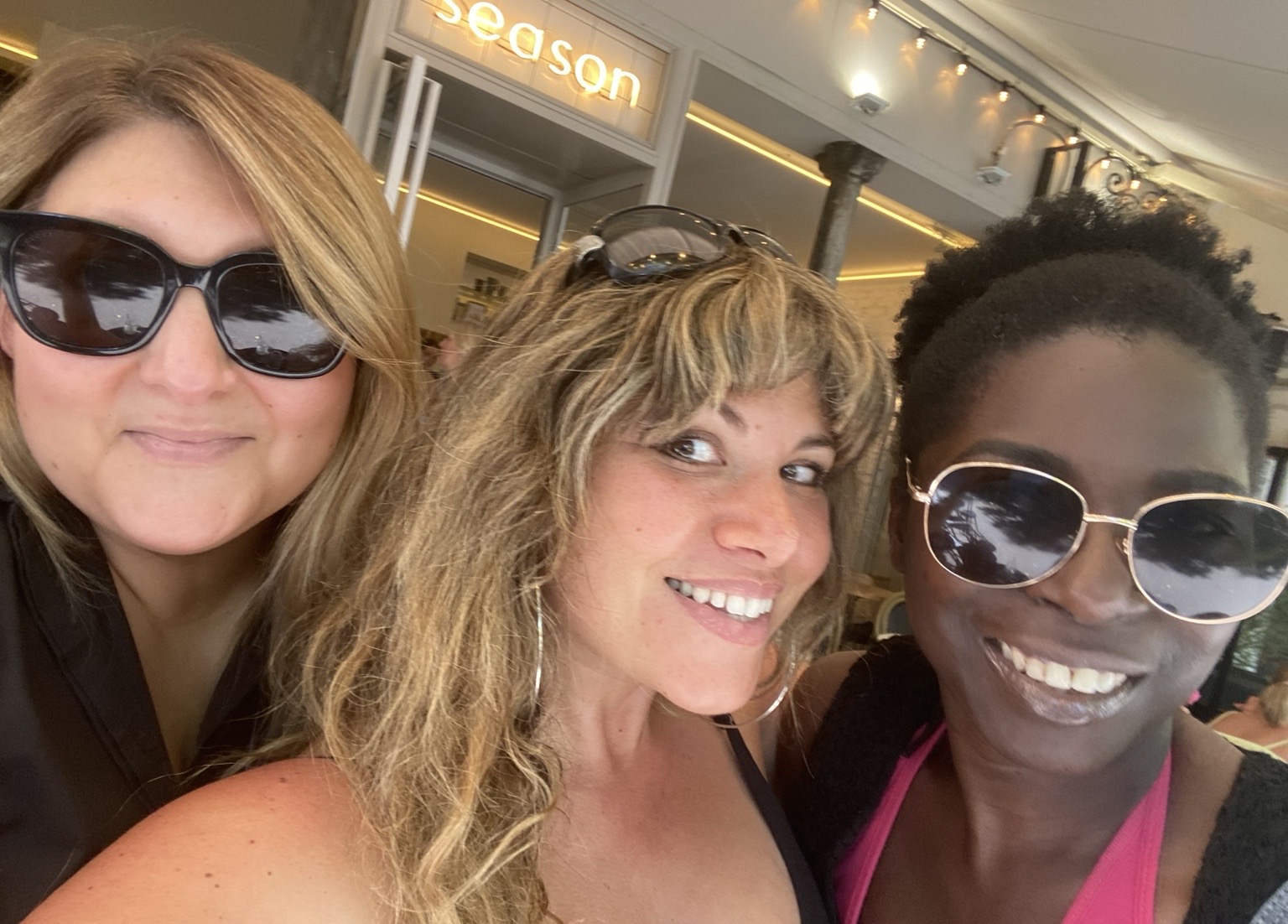
Rachel Suissa with vocal coach Géraldine Allouche and music supervisor Clémentine Koumenda.
Clémentine, the Score and 63 Musical Moments
My friend Clémentine Koumenda is one of those rare collaborators who understands my musical instincts almost before I have finished explaining them. We had already worked together on Dangerous Liaisons, where she helped bring roughly sixteen songs into the film. By then she knew my taste, my references and the way I use music emotionally.
When I started Greek Mothers Never Die, I asked whether she would take on the full role of music supervisor through Clementine SoundWorks.
There was one important difference this time. Our budget was roughly one tenth of what I had known on Dangerous Liaisons.
Clémentine accepted the challenge anyway.
And this is where the number 63 needs to be explained properly. Greek Mothers Never Die contains approximately 63 musical moments. That does not mean 63 songs.
Many of those moments come from the original score. Others are original songs. Others are additional tracks that had to be found, negotiated and cleared. The important thing is not that we somehow licensed 63 separate songs. We did not. The extraordinary part was the density of music across the film and the unusually large number of additional tracks we carried alongside a full original score for a production of this scale.
Composing While the Film Was Still Moving
At the center of the original score was our composer, Abraham Gómez Rosales.
Abraham had another challenge that audiences never see. He was composing while we were still editing.
The film was not a fixed object waiting politely for music. Scenes were changing. Timings were moving. Emotional beats were being refined. Abraham was writing to a target that could still shift under his feet, and the score had to evolve with the cut.
The soundtrack album that was later released contains seven tracks, including Agapi Mou, Snow White, The Greek’s Chief Tango, Greek Dinner, The Boat and the piano version of Paradise. But an album track list is not a cue sheet. The score lives throughout the film in many more individual moments.
Alongside Abraham’s work, we also had an unusually ambitious amount of additional music. That is where the creative dream began colliding with the legal and financial reality of independent production.
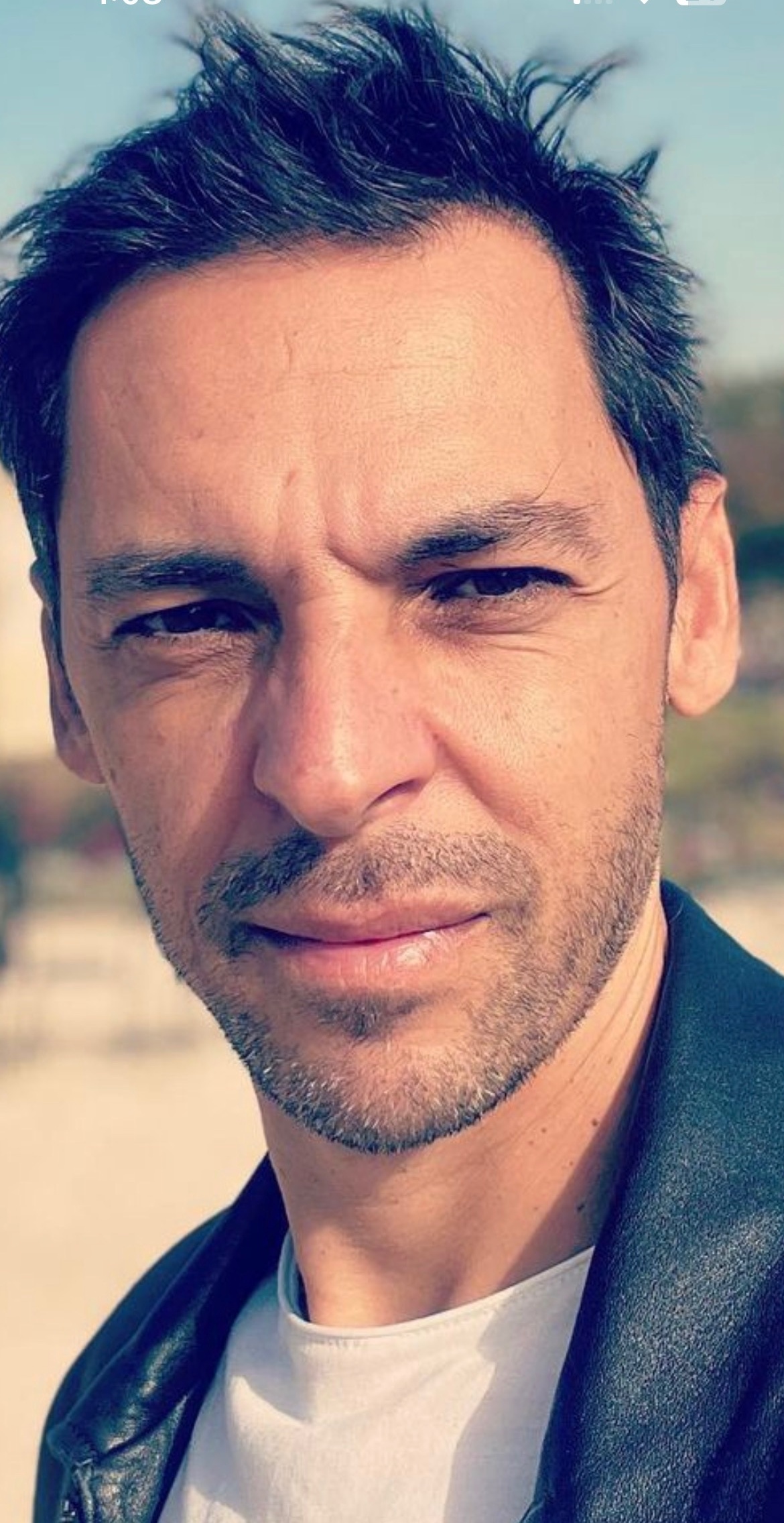
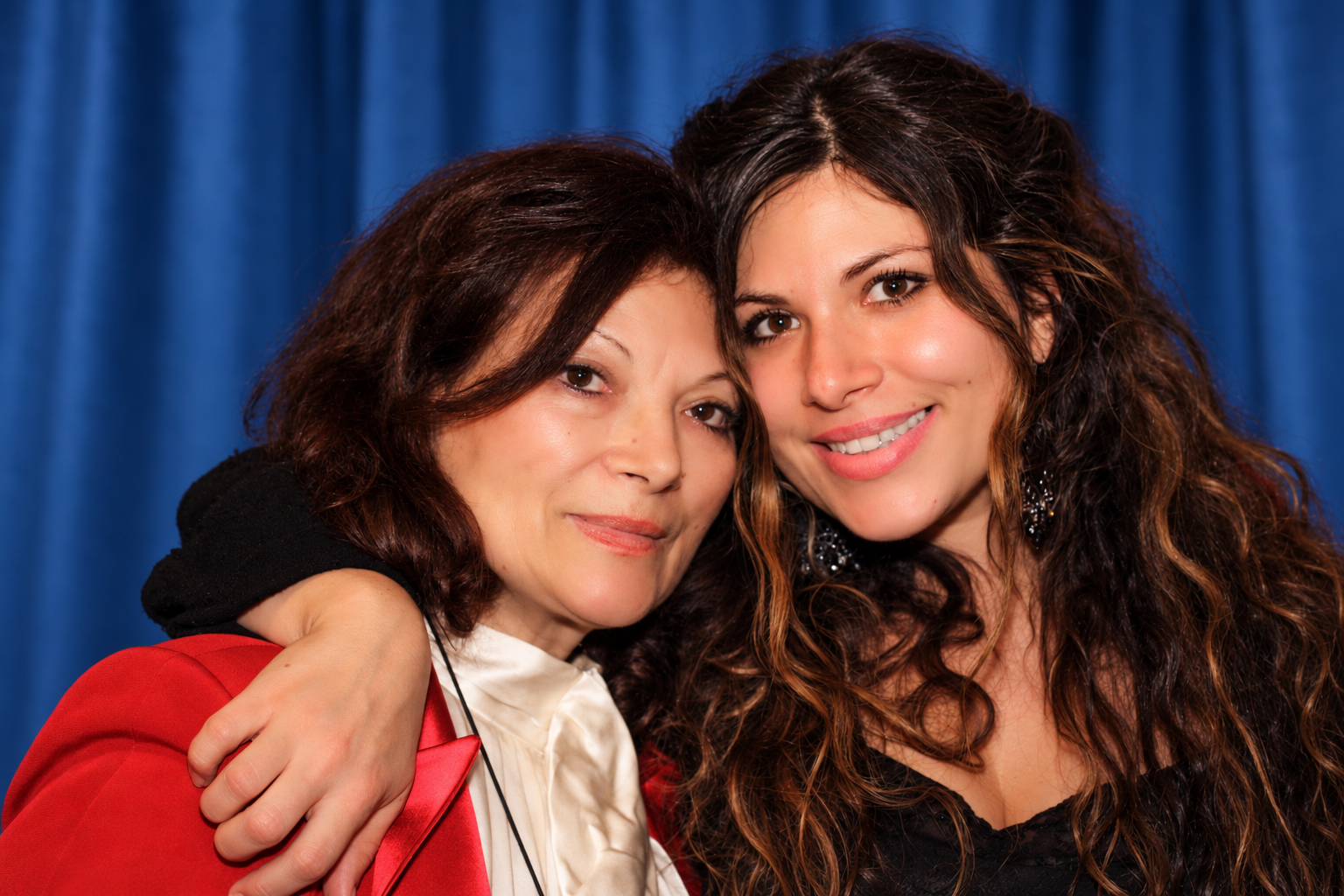
Composer Abraham Gómez Rosales, who created the original score for Greek Mothers Never Die.
Original Songs and Artists Who Played the Game With Us
I also wrote original material for the film, including Agapi Mou with Abraham. The fact that Ella is a songwriter meant that original music could not feel like an extra layer added after the fact. It had to belong to her life.
Wade Hunt Williams, Simon Herrera, Oscar Lesage, Rose Winn and other artists and collaborators also became part of the musical world of the film, whether through original material, collaboration or generous licensing arrangements. Some of them gave us rights on terms that made the impossible suddenly possible.
On an independent film, generosity like that is not a small gesture. A single track can disappear because one piece of the rights is financially unreachable. Every artist who chose to meet us halfway changed what the finished film was able to keep.
Some Songs Were Not Choices. They Were Memories.
Then there was the Greek music.
I did not choose those songs because I wanted recognizable Greek names in the credits. Some of them had been living inside me for years.
One of the songs connected to Pantelis takes me straight back to my father, to Olympe, to the Greek taverna and to an entire world of memory that existed long before I ever imagined making this film. It was not simply a track I liked. It belonged to a place inside me.
And then there was Yannis Ploutarchos.
His connection to my family goes much deeper than music. When my brother was ten and seriously ill with brain cancer, we met Yannis in Greece. He barely knew this little boy, yet he showed him extraordinary tenderness. He became attached to him and was simply present and kind at a moment when kindness carried enormous weight.
Years later, putting Yannis’s music inside a film that was itself so connected to Greece, family, loss and memory did not feel like selecting a song from a catalogue. It felt like bringing a piece of my own history into the movie.
Two of his songs appear in the film, Kamia Den Miazi Me Sena Matia Mou near the beginning and Paramilao much later. Their presence mattered to me for reasons that had nothing to do with prestige.
These songs were not interchangeable. They carried memory.
That is why the practical answer, simply replace the song with something cheaper, was sometimes not emotionally neutral. The replacement might have been beautiful. It just would not have meant the same thing.
Some songs were not choices. They were memories.
Behind the Rights Were People
Wanting a song and being legally able to place it inside a film that may travel internationally are two entirely different things.
With Clémentine leading the music supervision, we started trying to reach the people behind the works and recordings. What could have remained a purely contractual process became surprisingly human.
At AUTODIA, Christina Mergoupi helped us navigate the publishing and synchronization side of the Greek rights process.
At MINOS EMI, Universal Music Greece, Angela Kollia helped us with Greek music licensing on the master side.
And when we were trying to make the Ploutarchos music possible, Maria, Yannis’s wife, remembered my family and our story. She did everything she could to help us.
At another point, one of the composers connected to music we wanted had passed away, which meant another layer of research, permissions and people to locate.
Again and again, behind the catalogue, the contract, the company or the rightsholder, there was a person. Someone who remembered. Someone who listened. Someone who understood why a particular song mattered. Someone who said, let us see if we can make this work.
The Risk of Loving Too Much Music on an Indie Film
There is also a less romantic side to all of this, and it matters.
Putting a large amount of additional music into an independent film is a genuine risk. Not only while you are editing, but for the future life of the movie.
When a major studio or platform finances or acquires a film, there are teams, lawyers and substantial budgets built to handle music clearances. On an independent production, you cannot assume that somebody bigger will eventually arrive and take the problem away.
The producer may still be dealing with those rights years later.
A festival permission is not necessarily the same thing as a worldwide distribution license. A limited term is not the same as a perpetual right. A song may involve publishing rights and a separate master recording. A new territory, a new platform or a later distribution opportunity can expose a gap you did not know would matter when you were first cutting the film.
That is one reason many independent films make completely sensible choices to simplify the music equation. They may lean more heavily on original score, commission music that can be controlled broadly, negotiate buyouts where appropriate, or simply keep the number of licensed tracks limited.
We chose a more complicated route.
Not because we thought our film was somehow above independent filmmaking. Quite the opposite. I love what independent filmmaking makes possible. But we did not want the size of our resources to determine the size of the film’s musical imagination.
We tried to apply the same level of care, clearance discipline and musical ambition I had experienced on a much larger Netflix production, then find human scale solutions that could actually work for us.
The resources were smaller. The care could not be.
The Work the Audience Never Sees
Music supervision is one of those jobs that succeeds when the audience has absolutely no idea how difficult it was.
They hear a song for two or three minutes. They do not see the weeks of emails behind it.
Who owns the composition? Who owns the master? Who controls the publishing? Which territories are covered? For how long? Which media? Festivals only? Streaming? Television? Transactional video? Worldwide? What happens if the distributor changes? What happens when the term expires? What happens when a rightsholder cannot be located?
And eventually, how much does all of this cost?
Some of our clearances had to be handled in stages. We needed music to exist while the film was being edited and shown, then broader rights as the film moved toward distribution. Every new step could reopen a conversation that we thought was finished.
That is why Clémentine’s role went far beyond finding songs I liked. She was protecting the future usability of the film while trying to protect its musical identity at the same time.
That balancing act is enormous on any production. On ours, it sometimes felt gargantuan.
A Film Built on People Saying Yes
Looking back, there is a pattern running through the entire musical journey.
Clémentine said yes when I asked her to take on a music supervision challenge wildly disproportionate to our resources.
Géraldine said yes when I called her with almost no time and asked her to help us build believable singing performances from thousands of miles away.
Abraham kept composing while the film itself was still moving.
Artists trusted us with their work.
Christina helped. Angela helped. Maria remembered.
Rights holders met us halfway. People who knew us helped. People who had never met us helped.
Somewhere between the score, the songs, the recordings, the edits, the licenses, the rights, the emails, the negotiations and approximately 63 musical moments, we ended up with the musical world I had imagined.
Not a cheaper approximation of it.
The musical world itself.
Was it financially risky? Yes.
Was it administratively exhausting? Absolutely.
Would I remove the music now? No.
What I Hear Now
When I watch Greek Mothers Never Die now, I do not hear 63 cues.
I hear Ella finding her voice.
I hear Greece.
I hear the taverna.
I hear my father.
I hear memories of my brother.
I hear friends who came back from another film to help me make this one.
I hear a composer writing while we were still cutting.
I hear artists who trusted us with something they had created.
And I hear the people behind the paperwork who chose, for whatever reason, to care.
Maybe that is why the music never felt like an accessory to Greek Mothers Never Die.
It was never there to rescue the story.
It became one of the ways the story could breathe.
And in some places, one of the ways my own memories could breathe with it.